
From the Patient’s Bedside to Silicon Valley
BIQ Health Solutions Strengthens AI Expertise to Improve Healthcare Solutions There is a question that every technology company faces today: […]
BIQ Health Solutions Strengthens AI Expertise to Improve Healthcare Solutions
There is a question that every technology company faces today: what should we do with artificial intelligence? At BIQ Health Solutions, the answer begins with a simple conviction: before bringing AI into hospitals, we need to learn how to use it effectively within our own organisation. Knowing the tools is not enough. We need to understand their potential, recognise their limitations and develop the skills required to turn innovation into value for our customers.
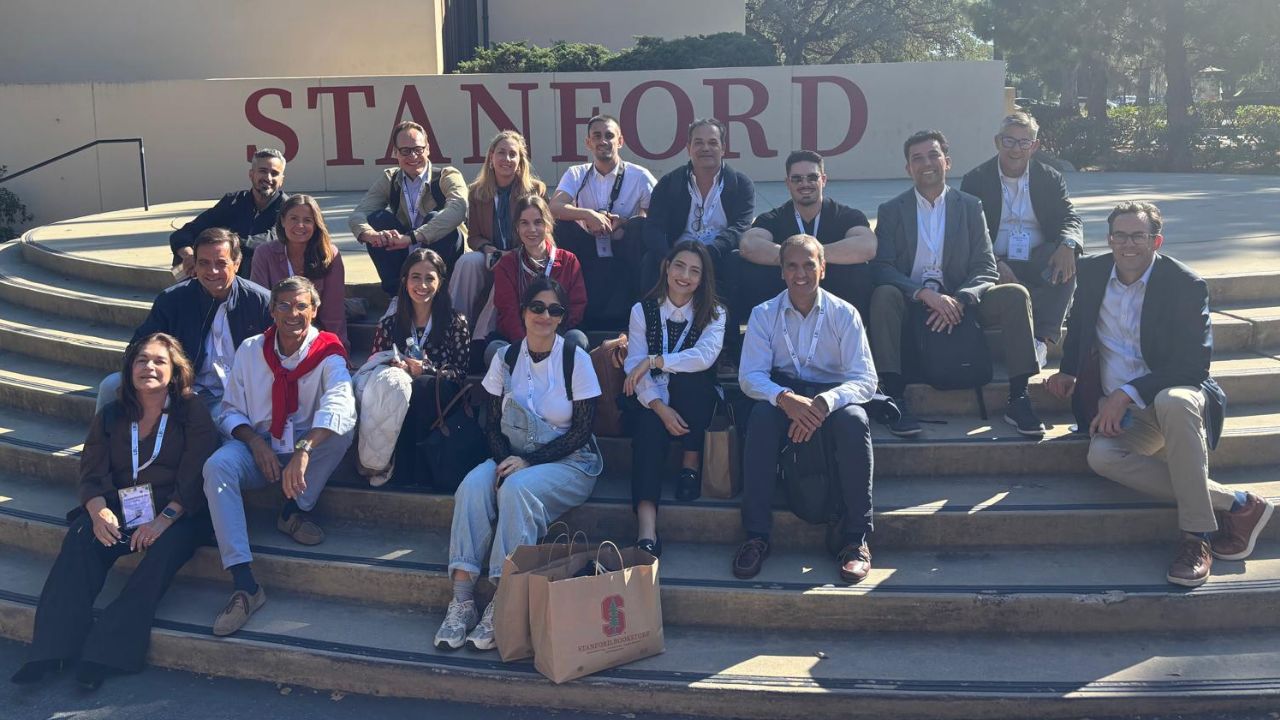
It was with this mindset that Jorge Alves, CEO, and João Mendes, CIO, took part in GSI AI Frontier 2026, held from 28 September to 2 October in San Francisco and Silicon Valley. Organised by Global Strategic Innovation in partnership with LBC, this executive programme has run for more than 50 editions and brings together select groups of 15 to 20 business leaders with those shaping the future of AI.
Understanding, Experimenting and Implementing
Over five days, the programme included visits to Google DeepMind, Stanford University, AWS, Perplexity, LangChain and Sierra, among other organisations. It also featured two days at The AI Conference, one of the world’s largest gatherings dedicated to applied AI, bringing together more than 5,500 participants and speakers from OpenAI, Anthropic, Google, Microsoft and Meta.
Beyond exploring new technologies, the objective was to understand how to put them into practice. The journey began with strategy and identifying problems worth solving. It then explored how large language models and AI agents work, before moving on to implementation: turning pilot projects into solutions that operate reliably on a daily basis, measuring adoption and impact, and ensuring responsible governance.
Each participant worked on a specific challenge facing their organisation through the Capstone AI Blueprint. This exercise resulted in an action plan for the next 12 to 18 months, outlining priorities, metrics and an implementation framework.
Innovation Starts from Within
The discussions in Silicon Valley highlighted several clear messages. AI is evolving from conversational tools towards agents capable of carrying out complete tasks with a degree of autonomy. However, moving from experimentation to production still depends on people, processes and data quality, rather than technology alone.
Another recurring message was that the most successful organisations begin by applying AI to their own operations. They learn, evaluate results and only then bring that knowledge to their customers. Trust, governance and measurement are essential parts of this process.
For BIQ Health Solutions, the experience confirmed the direction of BIQHS Inside AI, the company’s project to integrate artificial intelligence into its daily operations.
“We went with many questions and came back with one certainty: we are aligned with what the most mature organisations are doing,” says João Mendes. “We heard repeatedly that AI is not something you simply buy; it is something you learn. You need to start internally, measure, make adjustments and only then scale. That is exactly what we are doing with BIQHS Inside AI.”
Stronger Skills, Better Solutions
The project is built around two complementary objectives. The first is to make internal operations more efficient by exploring the potential of AI in software development, customer support, technical documentation and project management. Freeing up time in these areas creates opportunities to focus more closely on work that requires expertise, experience and the ability to respond to hospitals’ needs.
The second objective is to deepen the organisation’s expertise: understanding what the tools do well, where they fall short, what risks they present and under what conditions they can be trusted. In healthcare, this learning process is inseparable from the responsibility of developing technology for those who care for people.
“We work with hospitals. We cannot deliver technology to our customers that we have not yet mastered ourselves,” João Mendes emphasises. “It is within our own organisation that we will learn, make mistakes and gain the experience needed so that, when AI eventually becomes part of our solutions, it does so with the level of safety that patients deserve.”
This approach places continuous improvement at the heart of innovation. The aim is not to add AI to solutions simply because the technology is available, but to prepare the organisation to integrate it wherever it can deliver value, with expertise and responsibility.
A Long-Term Commitment
The key findings are now being shared with teams across the company. The plan developed in Silicon Valley will be incorporated into the BIQHS Inside AI roadmap, with clearly defined priorities, performance metrics and a strong focus on training.
The ambition is for every employee to use AI effectively and responsibly, allowing the knowledge gained across the organisation to contribute progressively to improving the solutions offered to the market and the support provided to healthcare professionals.
It is this consistent effort, combining learning with practical application, that prepares the company to respond to its customers’ evolving needs.
Tools change, expertise grows and new possibilities emerge. The purpose remains the same: using technology to protect people.